Introduction
The nature of conflicts and competition is constantly evolving, today we witness a growing focus and emphasis on digital warfare and informational dimensions of conflict, which complement conventional military forces. Today, states not only compete through conventional military strength but also through information.
Information campaigns can increasingly shape political discourses, influence public opinion, and affect the relations between countries, as a result, traditional statecraft and digital influence are now closely linked. Social media has become especially important in this process, because it lets states and other actors reach large audiences quickly and take part in public discussions on a scale that was not possible before.
This transformation that states use to conduct their policies is especially relevant for the Indo-Pacific region, where the competition is growing increasingly complicated with high stakes involved. Japan has emerged as one of the significant states of the Indo-Pacific region, not only from a geographical point of view, but also because of its broader strategic importance in the region. The relations between Japan and China have a great impact on the security environment of the region and military development.
This growing interconnection of the information and geopolitical competition is what characterizes the rivalry in the Indo-Pacific region, with the narratives disseminated online capable of deciding the outcome of the real world processes.
Objective of the report
This report aims to capture the narratives circulated that are targeted towards Japan, to examine foreign intervention within Japan’s digital information ecosystem, with a particular focus on the narratives linked to China.
The report aims to answer the following questions:
- Q1
What narratives are being propagated?
- Q2
How are these narratives being amplified?
- Q3
Do these amplification patterns appear organic or coordinated?
Research approach
This study uses a combination of researcher led research and data driven social media analysis. This approach was selected because the research aims to understand what narratives are present, along with how they develop, who participates in them, how they are amplified, and whether the observed patterns appear to be organic or are potentially coordinated.
This research employs a combination of both approaches which allows the study to examine the information environment from both the content and behavioural perspectives. A strictly quantitative approach would show changes in activity and account behaviour, but would not be able to provide enough context to understand the meaning of the narratives, similarly, a purely qualitative approach would be able to provide context but would make it more difficult to measure the scale, timing, and patterns of activity across a large number of posts.
The methodology therefore begins with research identification of relevant geopolitical events and narratives and then is followed by analysis of the social media data. This allows the findings to be grounded in the wider political context while also being supported by observable patterns in the data.
Narratives analysed
The report recognises and analyses 8 different narratives. The narratives are further divided into 3 clusters based on their similarities.
Chapter 01
Japan's Defence and Militarisation Narratives
- China-Threat Denial Narrative
- Defence White Paper Narrative
- Japan Militarisation Narrative
Chapter 02
Japan's Alliances, Maritime Disputes & Internal Affairs Narratives
- Japan-NATO Narrative
- Maritime Disputes Narrative
- Internal Affairs Narrative
Coming soon
Chapter 03
Economic Coercion and Electoral Interference Narratives
- Election Bot
- Seafood-Ban Narrative
Coming soon
Methodology used for the analysis
The study uses OSINT (Open Source Intelligence) based research design to analyze social media behavioural patterns, including posts, account behaviour, engagement, timing, and the movement of narratives across language spaces. The study does not assume that unusual online activity is automatically evidence of an information operation. Instead, the data is examined for patterns that may help distinguish between normal discussion, event-driven activity, media amplification, external amplification, and potentially coordinated behaviour.
The research followed a two step approach:
- 01Researcher led narrative identification and contextual assessment.
- 02A data driven analysis of the narratives, its structures and the account behavior.
Steps of research
- 01Topic & context identificationManual identification of geopolitical topics relevant to the study. This step also involved identification of key events, developments and further narrowing of the topics of potential narratives to be further analysed.
- 02Broader timeline identificationThis involves manually determining the broader timeline to be able to proceed with the next step.
- 03Query developmentFraming of the query by classifying the keywords, hashtags, phrases that would be used to gather the data.
- 04Data collectionThe step involved extraction of the data from the keywords, hashtags and phrases identified earlier from social media platforms within the timeline decided. The data collected includes the posts, accounts, their behaviour, platform engagement etc.
- 05Data cleaning and validationIt involved checking the data for any inconsistency and removing irrelevant entities. It also involved a separation of posts that were pro or anti the topics selected.
- 06Data validationAn important step was the manual verification to see if the data extracted is relevant with no false positives and if the data collection needed any refinements.
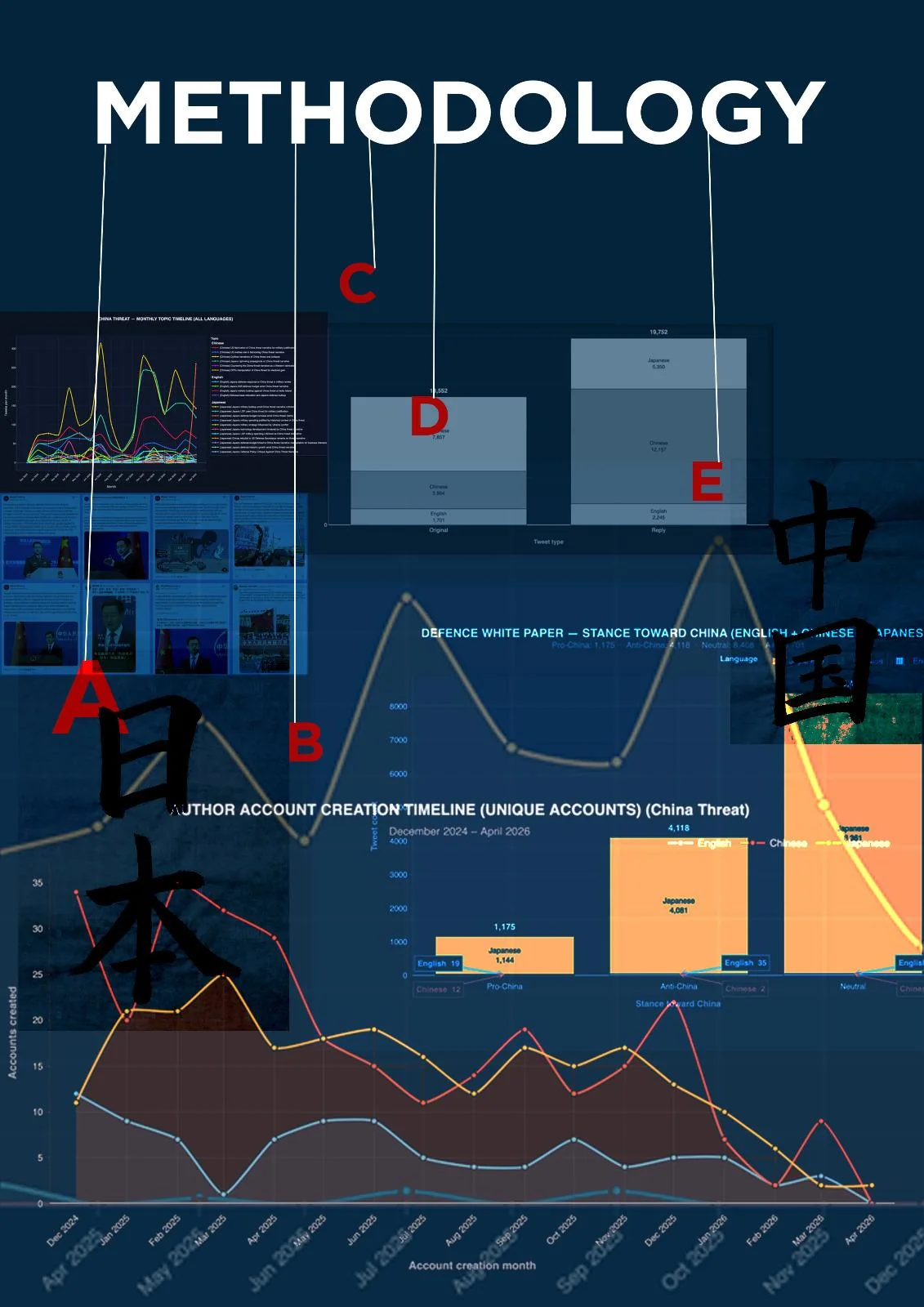
- 07Data analysisData analysis takes into consideration the analysis at various levels (7A–7E below).
- 08InterpretationThe data-driven findings were interpreted to assess if the patterns resemble an organic discussion, an event driven discussion, media driven discussion, externally amplified or a potential coordinated activity. The findings are interpreted by considering several indicators together, as no single indicator is treated as proof of coordinated behaviour. Instead, the study looks for combinations of indicators that may provide stronger evidence of a particular pattern, this may include a high volume of posts, a sudden increase in activity, a large number of low-follower accounts, repeated messaging, or activity across multiple languages.
7 · Levels of data analysis
- 7A — Narrative and content analysis
- From the posts collected dominant topics, claims, major actors, changes in the narratives were looked into. It could also involve the manual clustering of the narratives according to similarities and researchers interpretation.
- 7B — Timeline analysis
- At this stage the data was analyzed to identify the exact timeline between which the narrative became active, when was the increase in activity, when there was a sustained activity and the peaks.
- 7C — Stance analysis
- It involved the classification of the posts according to the orientation towards the selected subjects. For this report the analysis was largely divided in pro, anti or neutral towards China.
- 7D — Account analysis
- This is the analysing of the overall account behaviour. It involves the number of unique accounts, follower/following distribution, account creation date, posting behaviour by tracking original posts versus replies. This was also looked at to understand who participated in the narrative dissemination but also how they participate.
- 7E — Cross-lingual analysis
- The report examines the data set of three languages: English, Japanese and Chinese. This is done to evaluate differences in narrative framing, in volume of the posts and in stance of the posts in each of the languages. The study also lists accounts that appear in more than one language. Overall a cross lingual analysis helps to track the movement of narratives for different audience communities.
Analytical framework of the report
The report is based on the ABCDE framework which stands for Actor, Behaviour, Content, Degree and Effect. It is an analytical model used by researchers and policymakers to examine information warfare, foreign influence operation and disinformation campaigns. The framework is recognised by the European Union and was introduced to help institutions speak the same language when talking about tracking foreign interference.
Actor
The accounts and participants involved in the narratives.
Behaviour
Posting, replying, amplification and account-level activity.
Content
The narratives, topics, claims, frames and positions expressed.
Degree
The volume, reach, timing and scale of the activity.
Effect
How narratives develop and spread, including across language spaces.
The ABCDE framework is particularly relevant to this study because the research does not focus only on the content of narratives. It examines actors by identifying the accounts and participants involved in the narratives, and behaviour by analysing their posting, replying, amplification, and account level activity. The degree is considered through the volume, reach, timing, and scale of the activity, while content focuses on the narratives, topics, claims, frames, and positions expressed, finally, effect examines how narratives develop and spread, including how they appear across different language spaces. The framework therefore provides an overall structure for bringing together these different forms of evidence and examining online narrative activity in a systematic manner.
To understand the framework in detail you can refer to: ABCDE Framework | Debunk.org
Temporal scope of narrative analysis
Time period covered: December 2024 – April 2026.
The study uses a defined observation period to examine how narratives develop over time. The temporal scope is important because amplification patterns cannot be understood through a single snapshot of activity.
The analysis therefore examines:
- when a narrative becomes active
- how activity develops over time
- when major peaks occur
- whether activity declines or remains sustained
- whether different narratives peak simultaneously
Necessity of a longitudinal time period
A longer observation period makes it possible to identify patterns of activation. For example the analysis can distinguish between:
- a short-lived reaction to a breaking event
- sustained narrative activity
- repeated waves of mobilisation
- sudden and synchronised increases in activity
- the activation of pre-existing accounts during a specific event window
Narrative-specific time window
Although the study uses a common overall observation period the individual narratives may have different periods of heightened relevance. The analysis identifies key activation period for each narrative by examining:
- the timeline of monthly activity
- the major volume surge
- the relevant real-world event or trigger
- the period during which changes in posting behaviour become most visible
Social media platform analysed
The analysis is conducted primarily using data collected from the social media platform X (Twitter). The platform was selected as it provides significant data for efficient collection and examination of:
- real-time reactions to political and geopolitical developments
- interactions between individual accounts, media organisations and official actors
- reply-based engagement
- cross-lingual communication
- account-level behavioural patterns
- the circulation and amplification of narratives
The report therefore presents not only what the content of the post is but also the behaviour of the accounts and how those accounts participate in the discussions on the topic.
Analytical tool used
The study uses the in-house-built ThinkFi Dashboard as the primary tool for social media data collection and analysis. The dashboard provides analytical capabilities across multiple social media platforms, including X (Twitter), Instagram, Bluesky, and TikTok. For this report, however, the analysis is based exclusively on data from X. The ThinkFi Dashboard is available at dashboard.thinkfi.net.
The ThinkFi Dashboard provides a range of analytical functions for examining social media activity. These include hashtag analysis, user analysis, network graph analysis, query analysis, timeline analysis, post creation analysis, account creation analysis, stance analysis, potential bot behaviour analysis, and reply and retweet analysis, these functions allow researchers to examine content and activity associated with specific topics, accounts, hashtags, and time periods.
For this study, these analytical functions were used to examine the content, timing, engagement, account activity, amplification patterns, and interaction structures associated with the selected narratives on X. The ThinkFi Dashboard therefore served as the primary analytical environment for organising and examining the social media data used in the report.
Forthcoming reports
Throughout September, three successive reports will be published, each report focusing on each of the narrative clusters mentioned. The first, Chapter 1: Japan’s Defence and Militarisation Narratives, analyses the narratives China Threat, Defence White Paper, and Japan Militarisation Narrative. The second chapter of the report titled Chapter 2: Japan’s Alliances, Maritime Disputes & Internal Affairs, would examine the next set of narratives: Japan-NATO, Maritime Disputes, and Internal Affairs Narrative. The last report titled Chapter 3: Economic Coercion and Electoral Interference Narratives would study the Seafood-Ban and Election Bot narratives.
Key terms and analytical definitions
- Amplifier Layer
- A set of accounts whose primary function is to spread and repeat existing messages rather than generating original content.
- Coordinated Inauthentic Behaviour (CIB)
- A pattern in which multiple accounts work together in an organised but deceptive way to promote a narrative or manipulate online discussion.
- Corpus / Corpora
- The full body of posts collected for a given narrative or language group and used as the basis for analysis.
- Counter-Narrative
- A narrative intended to challenge, rebut, or undermine another narrative.
- Cross-Lingual Accounts
- Accounts that post in more than one language, enabling narratives to be carried across different audience communities.
- Cross-Lingual Amplification
- The spread of narratives across different language communities through accounts operating in more than one language.
- Cross-Lingual Core
- A group of accounts active across multiple language communities that consistently promote the same narrative.
- Disposable Accounts
- Accounts created for short-term use in a campaign, then abandoned once their purpose is served.
- Distribution Node
- A high-follower account that serves as a key point for spreading content to a large audience.
- Follower Distribution
- The distribution of accounts across follower-count ranges, used to assess network structure and reach.
- High-Reach / Low-Reach Accounts
- Accounts with a large number of followers (high-reach) versus accounts with very few followers (low-reach).
- Influence Operation (IO)
- A deliberate, often covert campaign designed to shape public opinion or steer online narratives toward a particular outcome.
- Language-Segmented
- A pattern in which activity is deliberately divided across different language audiences, with tailored messaging for each.
- Message Discipline
- The consistent repetition of the same narrative, talking points, or framing across multiple accounts with little variation in wording or position.
- Near-Zero Base
- A group of accounts with very small audiences, typically having very few followers. Large volumes of activity from such accounts may indicate coordinated amplification rather than organic influence.
- Organic (vs Coordinated)
- Activity that arises naturally from genuine user interest, as opposed to activity that is planned and directed as part of a campaign.
- OSINT (Open Source Intelligence)
- The collection and analysis of information drawn from publicly available sources, such as social media platforms.
- Reply-Brigading
- Coordinated activity where multiple accounts reply to targeted posts or discussions to push a specific message, create the appearance of consensus, or shape the conversation.
- Reply-Insertion
- The act of posting replies within existing discussions to introduce or reinforce a narrative without creating a new conversation thread.
- Reply-Insertion Amplification
- A tactic where accounts increase a narrative's visibility by repeatedly inserting replies into existing conversations rather than creating original posts.
- Reply-to-Original Ratio
- The relationship between the number of reply tweets and original tweets. A high ratio suggests users are engaging mainly through replies rather than posting original content.
- Seeded Amplifier Accounts
- Accounts that appear to have been created in advance and deliberately placed within a network to boost a narrative at the appropriate moment.
- Stance Asymmetry
- A pattern in which accounts active across multiple languages consistently favour one side of a narrative, suggesting directional intent rather than neutral observation.
- Stance Classification
- The categorisation of content as pro-, anti-, or neutral toward a subject.
- State-Affiliated / State-Actor
- Accounts that are linked to, funded by, or directly operated by a government or government-aligned entity.
- Topic Cluster
- A group of posts discussing a common theme identified through clustering analysis.
- Tradecraft Signal
- A behavioural pattern that may indicate coordination, influence activity, or organised information operations.
- Volume Surge
- A sudden increase in posting activity around a topic or event.
- Wire-Service Pass-Through
- A channel that functions primarily by republishing news headlines or existing reporting, rather than contributing original commentary or analysis.
- 32-Column Scrape
- A structured dataset collected from X/Twitter containing 32 data fields per post, such as account name, tweet text, follower count, and timestamp.
References
On the ABCDE framework
- Debunk.org. (n.d.). ABCDE framework. Retrieved September 1, 2026. debunk.org
- Pamment, J. (2020, September 24). The EU's role in fighting disinformation: Crafting a disinformation framework. Carnegie Endowment for International Peace. carnegieendowment.org
- European External Action Service. (2024). OSINT guidelines: How to detect and analyse identity-based disinformation. eeas.europa.eu
Studies using similar foreign interference and coordination-detection methodology
- Doublethink Lab. (2022). 2022 Taiwan election: Foreign influence observation report. medium.com
- European External Action Service. (2023, February). 1st EEAS report on foreign information manipulation and interference threats. euvsdisinfo.eu
- European External Action Service. (2025, March). 3rd EEAS report on foreign information manipulation and interference threats. eeas.europa.eu
- Chi, C. (2025, August 25). Copypasta army: Vietnam smeared by bots backing Duterte on X. Philstar.com. philstar.com